

A storyboard from a script with a consistent cast
Turn a short script into six numbered storyboard panels with the same cast, props and screen direction, with the captions set in code.
- Playbook
Run it in ScenarioGPT Image 2.5 Sunburst
See it made
Run it in Scenario
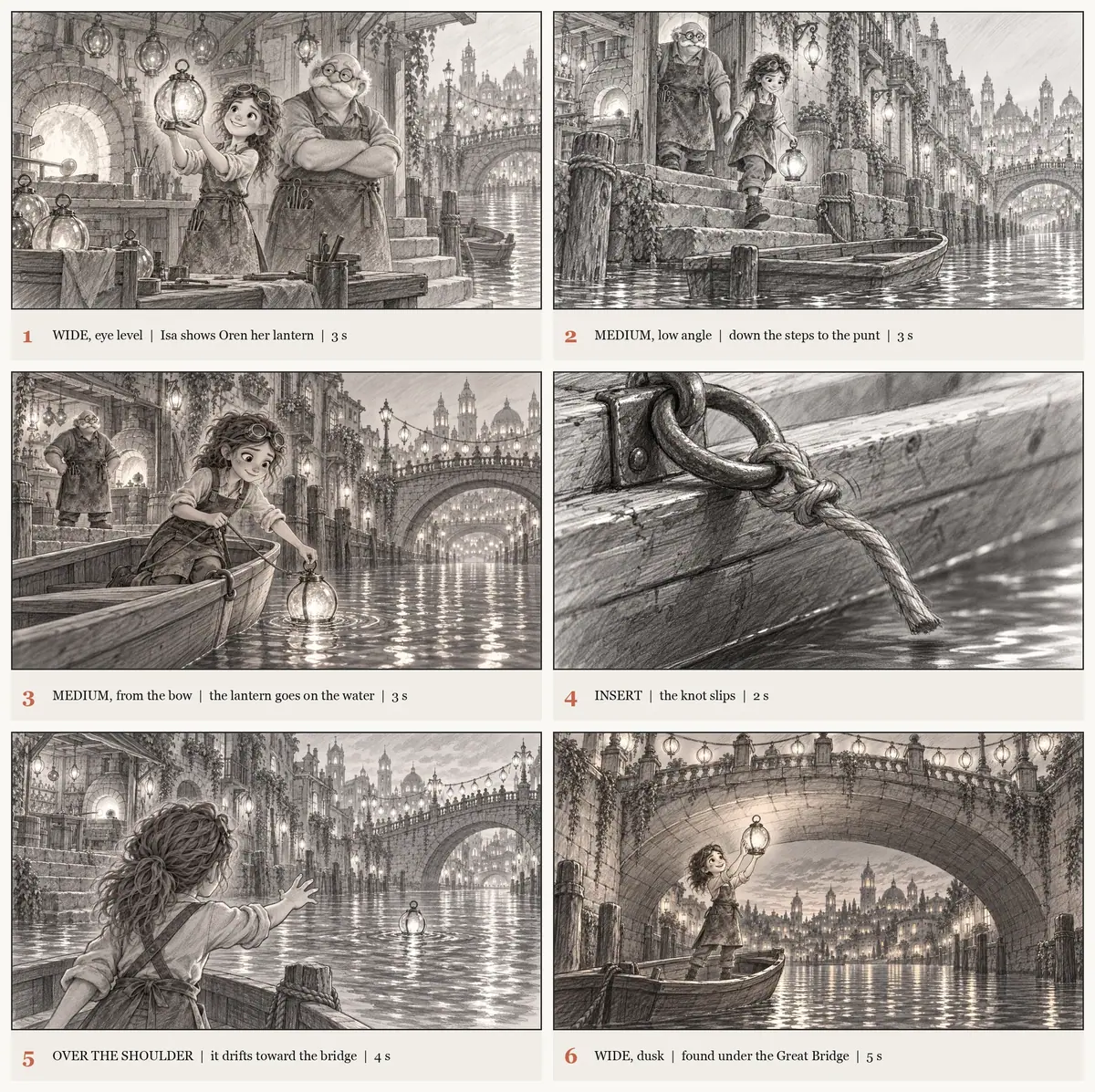
A six-panel storyboard for a 20-second sequence of an animated feature: numbered pencil panels with the same two characters, lantern and screen direction throughout, each captioned with shot size, action and duration. For directors, storyboard artists and producers who need to agree on a sequence before production.
The brief
| Field | Brief |
|---|---|
| Goal | A six-panel storyboard for a 20-second sequence, to agree on shots, order and timing before production |
| Script | 1 workshop, Isa shows Master Oren her finished lantern. 2 they go down the steps to the punt. 3 Isa sets the lit lantern on the water on a cord. 4 insert, the knot slips. 5 over the shoulder, the lantern drifts toward the Great Bridge. 6 dusk, under the bridge, Isa holds it up |
| Format | 16:9 panels, loose graphite pencil, captions outside the drawing |
| Fixed | The two characters, the lantern (round globe, exactly three brass bands, ring handle), the canal flowing left to right and the Great Bridge on the right in exterior shots |
| May vary | Pencil texture, background detail, exact poses |
| Accept when | Every panel reads at thumbnail size; cast and lantern match the sheets; screen direction holds; each shot shows who the shot line names, and no one else; no stray text in the art |
Isa, a 12-year-old glassblower's apprentice, and Master Oren live in Quillfern, an invented canal city of glass lanterns. The sheets made here can feed One scene, many angles.
Approach
- 1Shot listA language model drafts, you edit
- 2Cast sheetGPT Image 2.5 Sunburst, three views
- 3Prop sheetSunburst, lantern with exactly three bands
- 4PanelsSunburst, both sheets, shared block
- 5Captions and boardPython and Pillow
A storyboard fails when a character looks different from panel to panel, or when the camera crosses the line and the canal flows the other way. Both are solved before the first panel: continuity lives in two reference sheets and one shared prompt block, and each panel only adds its shot line.
- Reference sheets first. One cast sheet (both characters, three views, a few expressions) and one prop and location sheet, made in color because they serve every later stage. See Character reference sheet.
- Give each reference a role. The shared block says "Image 1 is the cast sheet" and "Image 2 is the prop and location sheet", and what to take from each (Give references a role).
- State the continuity rule in words. "In every exterior shot the canal flows from left to right and the Great Bridge is on the right side of the frame" (Decide what stays fixed).
- Name only who is in the shot. A shared block that describes both characters invites both into every panel. Panel 6 failed exactly that way.
- Keep text out of the model. Panel numbers, shot types and durations are set in code (Let code own what must be exact).
Models, as of October 2026:
- Capabilities: text to image, and image to image with two references.
- Model used: GPT Image 2.5 Sunburst at
highquality for the sheets and the panels. - Alternative: GPT Image 2.5 Flare. Compare both on two panels before committing to a whole board (Compare models on your brief).
Steps
-
Break the script into shots. One line per panel: number, shot size, angle, action with directions, duration in seconds (2 to 5). Let a language model draft the list (Create > Text, or Scenario Genie), then fix it by hand: the model proposes the cuts, you decide them.
PromptBreak this script into a storyboard shot list. One line per shot: number, shot size, camera angle, the action in one sentence, duration in seconds (2 to 5). Keep screen direction consistent and say who is on the left and who is on the right in every shot. Script: [paste the script] -
Make the cast sheet (Lock a character sheet). Create > Images, GPT Image 2.5 Sunburst, Dimensions 2048x1152, Quality
high, with Isa's approved portrait in Reference Images:PromptCharacter reference sheet for an animated feature film. The reference image is Isa: keep her face, freckles, wavy auburn hair tied back, brass goggles on her forehead, cream shirt with rolled sleeves, soot-stained brown leather apron, olive trousers and worn brown boots exactly as shown. Plain warm light-grey background, no text, no labels. Two characters, each shown full body in three views side by side: front, three-quarter, back. Same scale, standing on one faint ground line, empty hands. Left group, ISA: the 12-year-old glassblower's apprentice from the reference image. Right group, MASTER OREN: a stout elderly glassblower, a head and a half taller than Isa, bald with a thick white walrus mustache, round leather-rimmed spectacles, rolled shirt sleeves showing strong forearms, a long burn-marked dark leather apron over a faded blue shirt, grey trousers, heavy boots. Bottom row, small: four head close-ups of Isa (proud smile, surprised, worried, determined) and two of Oren (warm smile, laughing). Style: prestige painterly 3D feature animation, hand-painted textures, expressive appealing shapes, soft volumetric light, rich color. Even soft studio light. Clean gutters between figures. -
Make the prop and location sheet. Same settings, with a city mood image as reference. The prompt describes the lantern part by part ("a round amber glass globe the size of a melon ... held by exactly three thin brass bands that run from top to bottom, a small brass ring handle on top, a flat brass base"), then the Great Bridge ("one single wide stone arch"), Oren's workshop (round brick furnace, blue door, stone steps to the water) and the canal with a moored punt. Counting details is what keeps the lantern identical later.
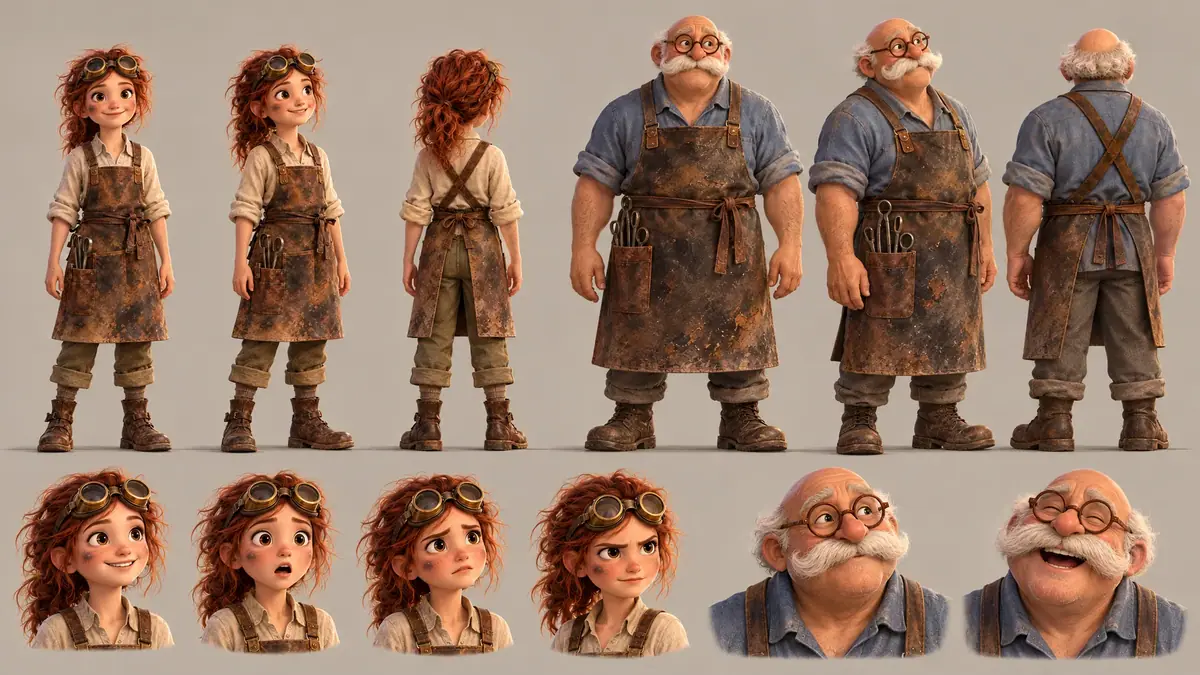
Cast sheet. 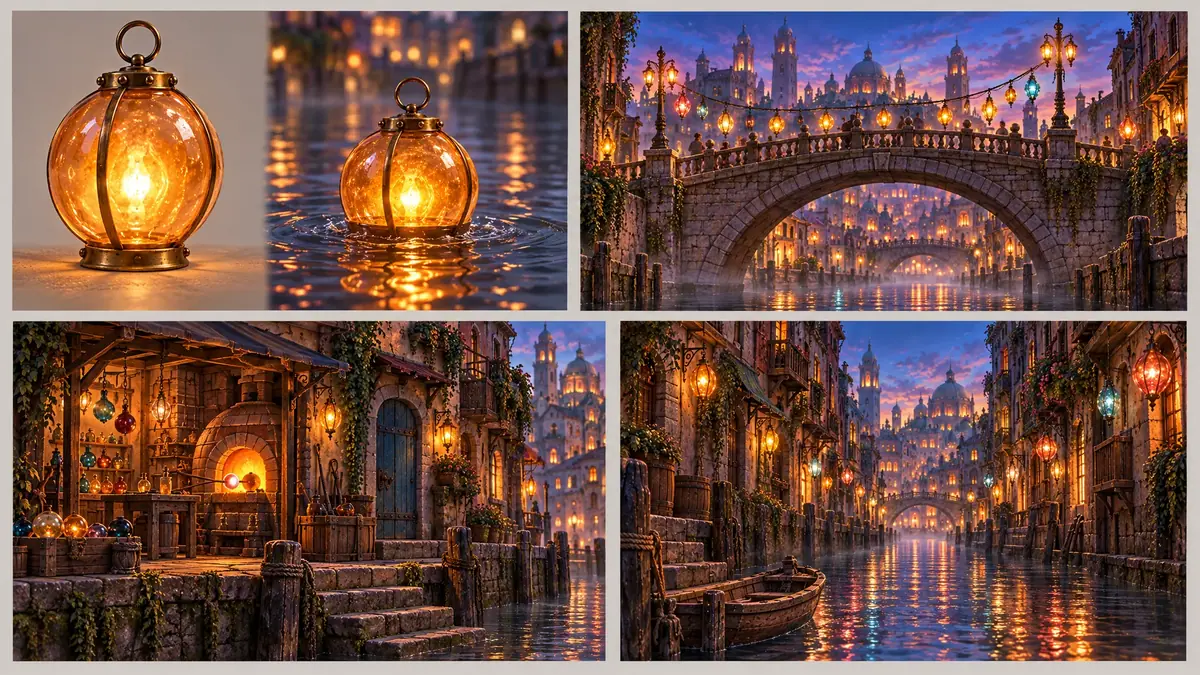
Prop and location sheet. -
Write the shared block. This text starts every panel prompt, unchanged:
PromptStoryboard panel for an animated feature film. Loose graphite pencil sketch on plain white paper, quick confident lines, light grey shading only, no color, no text, no numbers, no arrows, no panel border. Image 1 is the cast sheet: Isa, a 12-year-old girl with wavy hair tied back, goggles on her forehead, rolled shirt sleeves, a long leather apron, trousers and boots; Master Oren, stout and a head and a half taller, bald, thick white walrus mustache, round spectacles, rolled sleeves, long leather apron. Match their proportions, faces, hair and costume shapes. Image 2 is the prop and location sheet: Isa's round glass globe lantern with three brass bands and a ring handle on top, the single stone arch of the Great Bridge hung with lanterns, Oren's canal-side workshop with its round furnace and stone steps, and the canal between tall leaning houses. In every exterior shot the canal flows from left to right and the Great Bridge is on the right side of the frame. -
Generate each panel (Batch from a template). Reference Images > Select from Library: the cast sheet first, then the prop sheet. Dimensions 1536x864. Append one shot line to the shared block, for example:
PromptShot: 5. OVER THE SHOULDER, behind Isa standing in the punt. The lantern floats away from her on the current, left to right, toward the Great Bridge on the right side of the frame, getting smaller. Isa reaches one arm out after it.The six panels ran in parallel, about 45 to 55 seconds each.
-
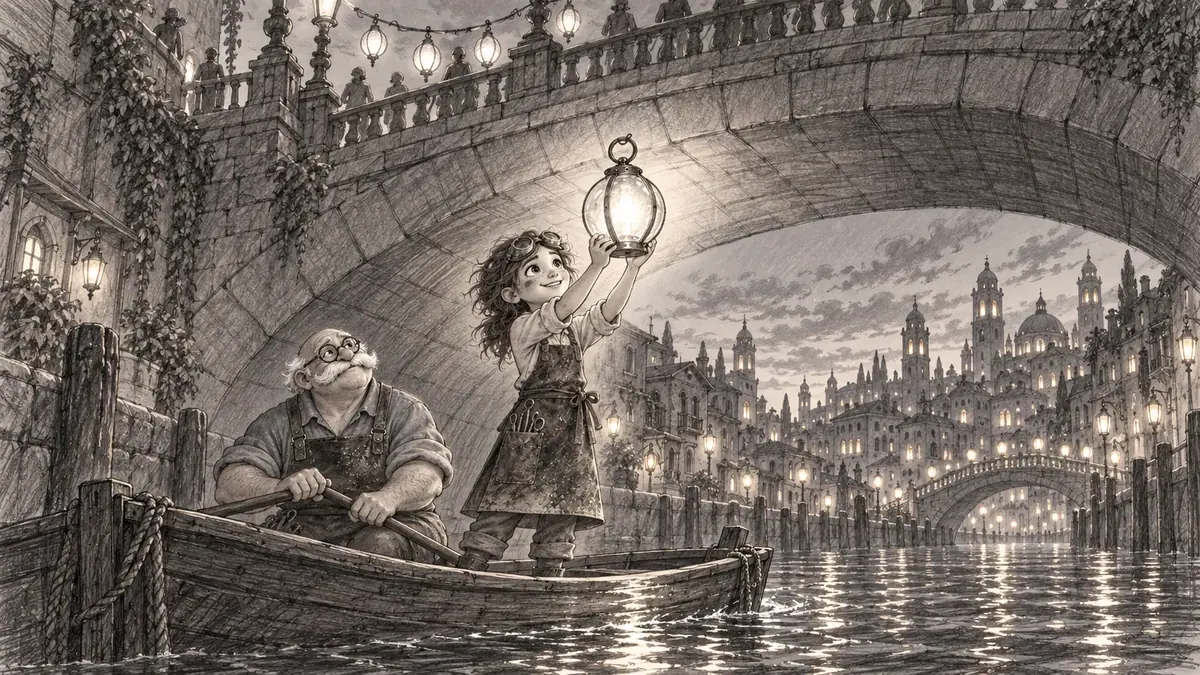
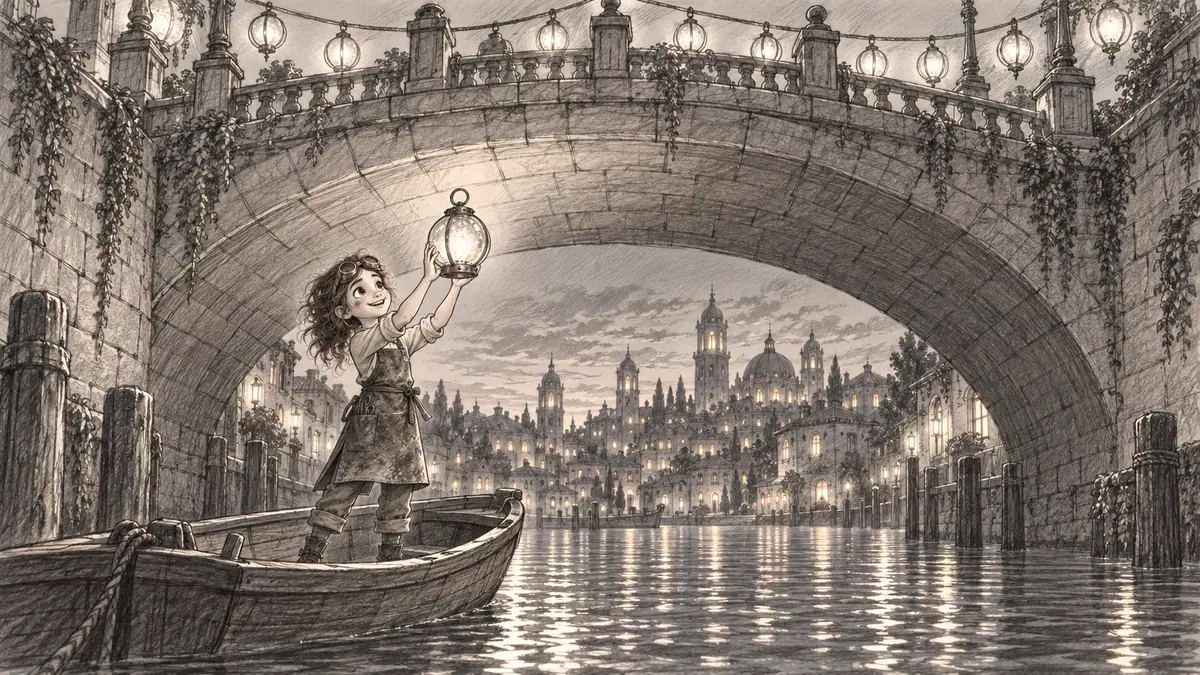
Inspect and retake. Check each panel against the sheets and its shot line. Panel 6 ("Isa stands in the punt holding the lantern high") came back with Oren rowing beside her: he stayed on the steps in panels 3 to 5, and the shot line has Isa alone. The retake removed Oren and the continuity rule from the block for this panel and named the shot's limits:
Prompt...Image 1 is the cast sheet: Isa, a 12-year-old girl with wavy hair tied back, goggles on her forehead, rolled shirt sleeves, a long leather apron, trousers and boots. Match her proportions, face, hair and costume shapes. Image 2 is the prop and location sheet: Isa's round glass globe lantern with three brass bands and a ring handle on top, and the single stone arch of the Great Bridge hung with lanterns. Shot: 6. WIDE, dusk, under the arch of the Great Bridge. Isa stands alone in the punt holding the lantern high in both hands, its warm light filling the underside of the arch and reflecting on the water; the hanging lanterns of the parapet glow above. She is UNDER the only Great Bridge in the story: no other bridge, arch or viaduct appears anywhere in the frame, and the canal beyond the arch opens onto calm water and rooftops only. -
Caption and assemble in code (Typeset text, never generate it). This run used Python with Pillow: each panel scaled to 1152x648 with a dark outline, a cream strip underneath with the number in Georgia Bold (terracotta) and "shot | action | duration" in Georgia, then two columns on one board. The captions come from the same JSON file as the shot lines:
Pythond.text((24, 703), str(p["n"]), font=georgia_bold_46, fill=(196, 101, 74), anchor="lm") d.text((90, 703), f'{p["shot"]} | {p["action"]} | {p["secs"]} s', font=georgia_28, fill=(17, 17, 17), anchor="lm")
With the Scenario MCP: model_run on model_openai-gpt-image-2-5-sunburst with referenceImages set to the two sheet asset ids, width: 1536, height: 864, quality: "high". Keep the shared block in a file and append each shot line in your script, so an agent cannot paraphrase it between panels.
Check the result
both characters keep their silhouettes (Oren's mustache and spectacles, Isa's goggles and apron); the lantern keeps its globe, bands and ring; the canal flows left to right and the Great Bridge sits on the right; each panel shows exactly who its shot line names; shot sizes differ visibly; the art contains no letters or numbers.
a character appears where the script does not put them; a landmark is duplicated; the lantern changes shape; a character changes height or costume; the screen direction flips; the model writes captions or numbers into the drawing.
 Rejected
Three smaller deviations were accepted and written in the board notes:
- More finished than "loose". Every panel came back as a detailed pencil rendering. That reads well in a pitch; for a fast rough pass, ask for "thumbnail sketch, under 30 lines".
- A thick rope in panel 4. The shot line said "thin cord". The insert still reads as the knot slipping.
- Distant bridges. Panels 1, 2, 3 and 5 show smaller bridges far down the canal through the arch, as the location sheet does. The Great Bridge stays the largest and on the right, so they read as the city's other bridges.
1Two takes of panel 6. The shot line: "Isa stands in the punt holding the lantern high." Oren stayed on the workshop steps in panels 3 to 5. Which take goes on the board?
Answer: B. A character the script did not put in the shot is a continuity break. The retake removed Oren from the block for this panel and wrote "Isa stands alone".
2Your pencil panels come back with the panel number and shot type written into the drawing. What is the fix?
Answer: A. The art must contain no letters or numbers. Captions set in code are always correct and legible.
Make it repeatable
- Save the kit. Put the two sheets, the shared block and the shot list in one collection. A new sequence with the same cast starts from the same kit (Organize your work).
- Build it as a workflow (Build your first workflow). In the Node Editor (New Workflow):
- a Text node for the shot list, and Split Text to turn it into one line per panel;
- a Prompt Builder that joins the shared block and the line;
- an Image Generator on GPT Image 2.5 Sunburst with both sheets wired to Reference Images, inside a Loop over the lines;
- an Approval node after the generator, so a reviewer can reject a panel before the board is assembled.
- Keep the captions in code. The caption script reads the same shot list, so captions always match the prompts.
- Next stages. The approved board feeds One scene, many angles and Long video from guided frames.
Runs and time
| Step | Model | Runs | Kept | Wait |
|---|---|---|---|---|
| Cast sheet | GPT Image 2.5 Sunburst | 1 | 1 | about 45 s |
| Prop and location sheet | GPT Image 2.5 Sunburst | 1 | 1 | about 50 s |
| Six panels, in parallel | GPT Image 2.5 Sunburst | 6 | 5 | about 55 s |
| Panel 6 retake | GPT Image 2.5 Sunburst | 1 | 1 | about 45 s |
| Captions and board | Python and Pillow | 0 | n/a | seconds |
Nine runs at about the same price each, so the board costs the number of panels plus two sheets and any retakes. The price shows on the Generate button before you run.
Variations
- Brand and marketing: a 30-second ad storyboard with a product sheet in place of the prop sheet; add the product's fixed details (label side, color) to the continuity rule.
- Learning: a training-video board where each panel is one step of a procedure, with the step text set in code under the panel.
- Games: a cutscene board; reuse the same shared block to generate the cinematic's key frames later.
- Different look: swap "graphite pencil" for "marker rough" or "gray-tone digital thumbnail" in the shared block; the sheets stay the same.
- Animatic: time each panel to its duration and add a scratch voice (Narration and speech).
If it breaks
- A character appears in a shot they are not in. Describe only the characters the shot names in that panel's block, and write "alone" when one character is alone.
- A landmark appears twice. Say there is only one ("the only Great Bridge in the story") and what lies beyond it.
- Characters drift in pencil. The color sheet carries cues a pencil panel cannot show. Repeat the shape details in words (goggles, walrus mustache, round spectacles).
- Text or numbers appear in the drawing. Keep "no text, no numbers, no arrows" in the shared block and set every caption in code.
- All panels look like the same medium shot. Name the shot size, the angle and a camera height in each line; vary them deliberately.