

Swap the actor and keep the performance
Make one reference performance, then have several characters perform exactly the same moves with a motion-control model, checked pose by pose.
- Playbook
Run it in ScenarioKling V3 Pro - Motion Control Minimax H3 Max Recast Seedance 2.5 Minimax H3
See it made
Saltwren, an invented sparkling sea-water brand, wants one short dance for its launch spots, performed by three faces of the brand. One invented dancer performs a 5-second routine on a locked camera. Three characters then perform exactly her moves: the Saltwren wren mascot, a stylized lifeguard and a photoreal swimmer in her seventies.
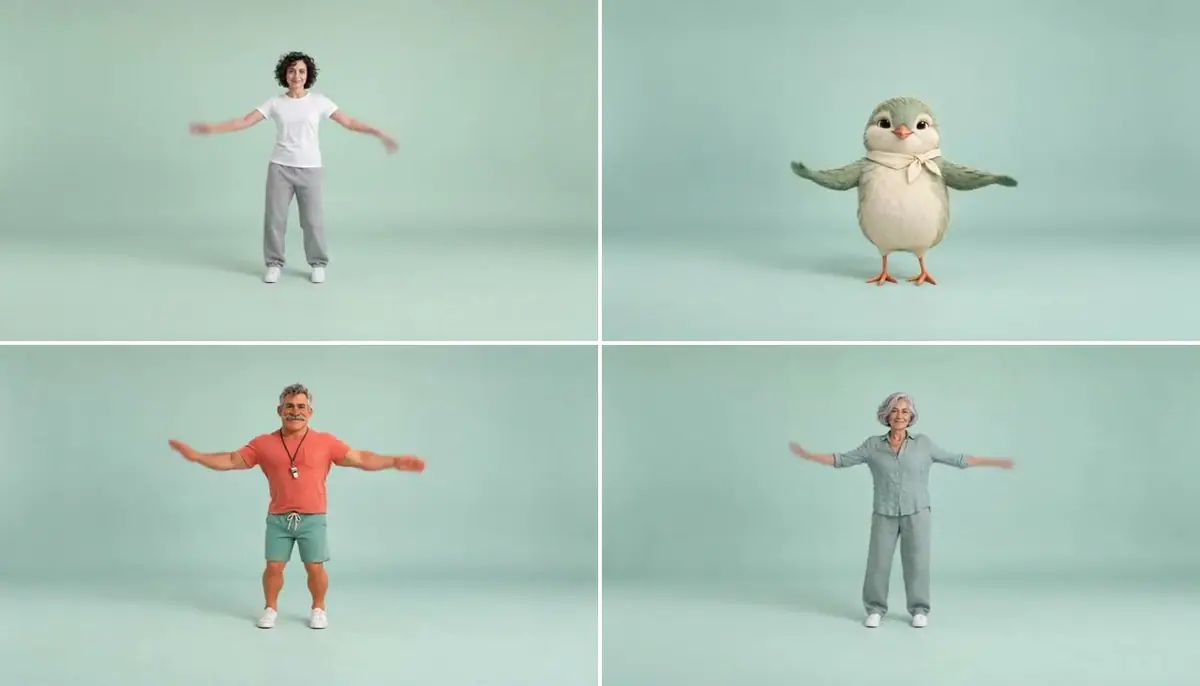
Watch the video: https://ufgc0c9mhl4ueq76.public.blob.vercel-storage.com/academy/95a79e18848ccb3ffbce643b83f5d5bb91ed81a5735b94b55432acd4376e4318.mp4
The brief
| Field | Brief |
|---|---|
| Goal | One reference performance, recast with three characters doing the same moves |
| Performance | 5 seconds: arms out, arms up, clap, half turn, hands on hips |
| Format | 16:9, 1344x768, 24 fps, 124 frames, the base take's own size and length |
| Fixed | Locked camera, framing, the performer's spot, every move and its timing, the sea-glass green studio and light |
| Changes | The character only: the wren mascot, a stylized lifeguard in his fifties, a photoreal former open-water swimmer in her seventies |
| Accept when | Every key pose lands at the same time as in the base take; the whole body stays in frame; design and face hold to the last frame |
Approach
- 1Base takeperformer still, Minimax H3, locked camera
- 2Cast stillssame spot, height and stance
- 3Shoot-outthree models on the mascot
- 4RecastsKling V3 Pro - Motion Control
- 5Track checkfive key poses, matching times
Motion transfer works best from a clean driving video: one performer, a locked camera, the whole body in frame, hands no higher than the head. So the performance is made for the job.
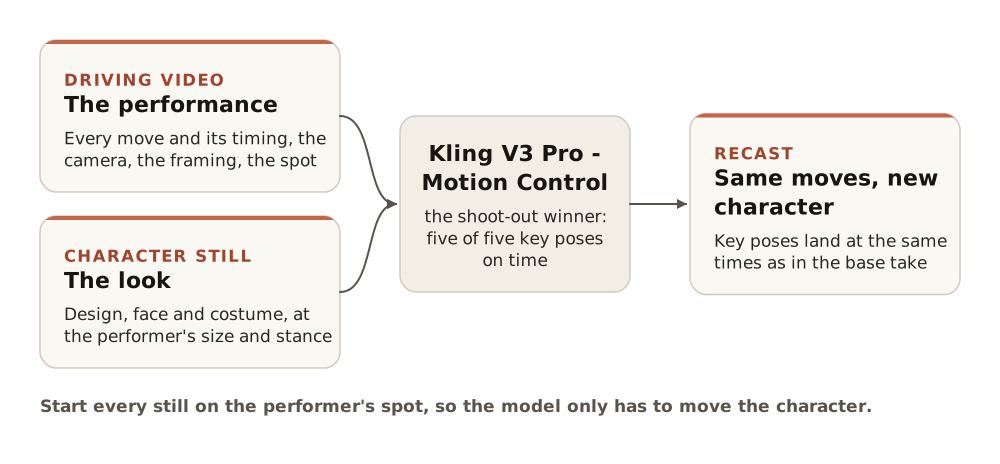
The driving video sets every move and its timing, the camera, the framing and the spot; the character still sets the design, face and costume, drawn on the performer's spot at her size and in her stance.
- Model used: Kling V3 Pro - Motion Control, the shoot-out winner: five of five key poses on time.
- Alternative: Seedance 2.5 in reference mode landed four of five and kept the full body in frame, but it took longer. Minimax H3 Max Recast, the most recent replace model, kept the design but fell behind from 3 seconds on, at more than twice the price. Cartwheel Mascot, the top recommendation for mascot swaps in October 2026, costs many times more per clip; not tested.
Steps
-
Make the performer still. Create > Images, Model GPT Image 2.5 Sunburst, Dimensions 16:9 (2048x1152), Quality high, two takes, 32 seconds. The studio color is the brand's sea-glass green, so every recast sits in the same world.
PromptFull-body photo of a dancer in a seamless pale sea-glass green photo studio, shot from a locked tripod at chest height, wide 16:9 frame. The dancer is an invented woman in her late twenties with short dark curly hair, wearing a plain white t-shirt, loose stone-grey sweatpants and white sneakers with no logos. She stands in a relaxed neutral stance facing the camera, arms loose by her sides, in the exact center of the frame. Her whole body from head to feet fills only about half of the frame height, with generous empty space above her head, below her feet and on both sides. Seamless pale sea-glass green backdrop curving into the floor, soft even studio light, a soft contact shadow under her feet. Photoreal, natural skin texture. No text, no logos, no other people. -
Make the base take (Animate from a first frame). Create > Videos, Model Minimax H3, the still as First Frame, Duration 5 s, Resolution 768P. 3 minutes 12 seconds. List the moves in order; keep the hands no higher than the head.
PromptThe camera stays perfectly still on a locked tripod: no camera movement, no zoom, no cuts. The dancer performs a short upbeat standing routine facing the camera, staying on the same spot in the center of the frame: she sways her hips side to side, waves both arms at shoulder height twice, claps once in front of her chest, steps left and right on the beat, makes a quick half turn to her left and back to face the camera, and ends with both hands on her hips. Her hands never go above her head, and her whole body from head to feet stays inside the frame the whole time. Smooth real-time motion, natural human movement. Same plain pale sea-glass green studio, no other people, no text. Soft sound of sneakers on the studio floor and one clap, no music, no speech.The take read the routine its own way: arms out, arms up to head height, a clap, a turn that shows her back, and hands on hips. That is fine: the base take is the master, and its own poses are what every recast must match. Then remove the sound:
ffmpeg -i base.mp4 -an -c:v copy base-silent.mp4. -
Make one cast still per character (Give each reference a role). The performer still in Reference Images is the layout; the prompt is the character. About 33 seconds each, in parallel. One pattern, one slot:
PromptReplace the woman in image 1 with [CHARACTER]. The character stands exactly where she stands: in the center of the frame, feet on the floor at the same place, the same height in the frame from head to feet, facing the camera in the same relaxed neutral stance with arms loose by the sides and empty hands. Keep the seamless pale sea-glass green studio, the soft even light, the soft contact shadow and the camera exactly the same. Only one character, nobody else, no text, no logos.The three character slots, as run. The mascot takes a second reference, the brand's can shot, for the wren mark and colors; its prompt adds "Use image 2 only for the wren mark and the brand colors, not for the cans" and ends with "no cans".
Promptthe Saltwren brand mascot: a plump, round little sea wren bird character standing upright, based on the small wren mark printed on the cans in image 2, with soft sea-glass green and cream feathers, a short perky tail, round dark eyes with white highlights, a tiny pale coral beak, small wings that work like hands, short orange legs with three-toed feet, and a little cream neckerchief; stylized 3D cartoon render with soft materials a stylized 3D animated-feature character: a sturdy, cheerful lifeguard in his fifties with a big bushy grey mustache, sun-tanned skin, a short-sleeved coral lifeguard shirt with a plain white cross-free pocket, sea-glass green board shorts, a whistle on a cord around his neck and white canvas sneakers; hand-painted textures with soft stylized shading and appealing exaggerated proportions a photoreal brand ambassador: an invented woman in her early seventies, a former open-water swimmer, with a short silver bob, light olive skin with natural wrinkles and freckles, a warm closed-mouth smile, wearing a loose sea-glass green linen shirt and matching wide linen trousers and white canvas sneakers; live-action commercial photographyThe wren came back shorter than the performer, as a small bird should. Accepted: the motion model sizes the character from the still and the video together, and the check in step 5 decides.
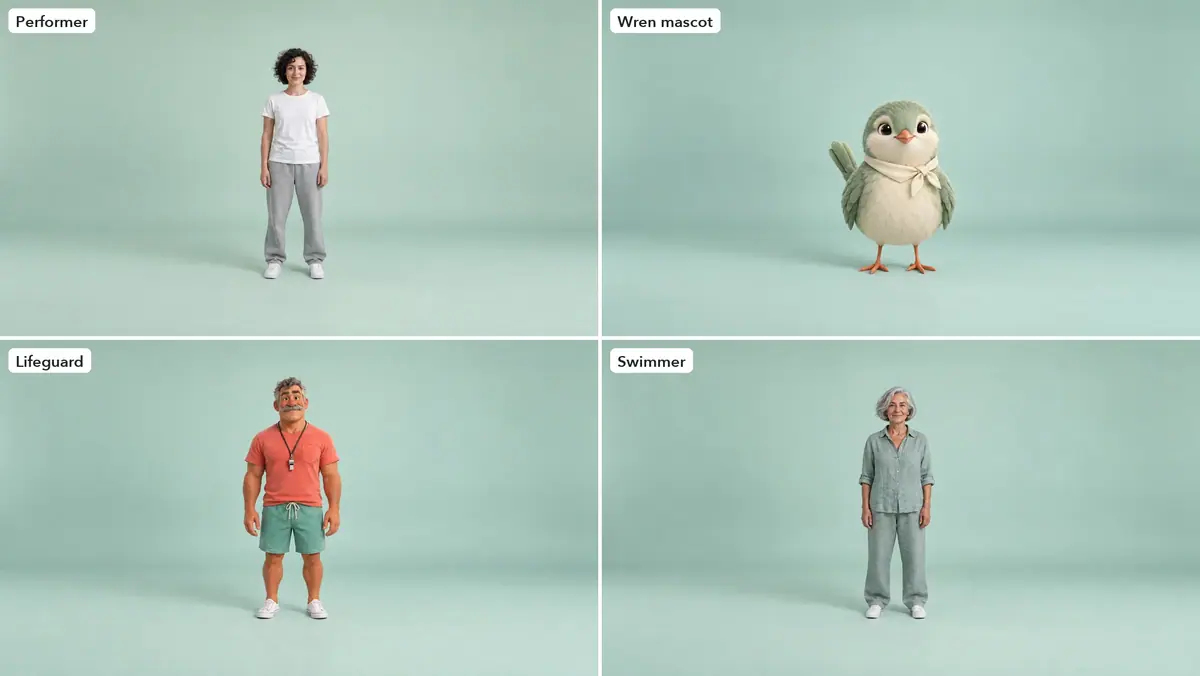
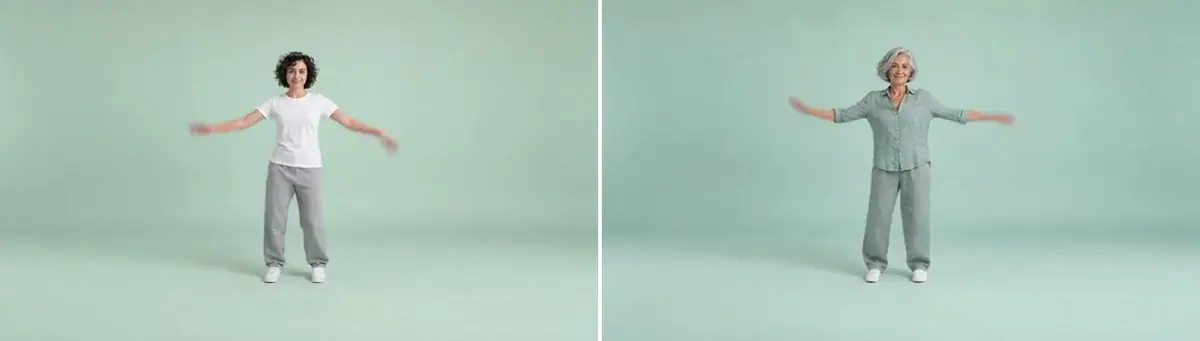
Performer still (top left) and the three cast stills: wren mascot, lifeguard, swimmer. -
Run a shoot-out on the hardest character (Pilot the hardest case). The mascot: round body, wings for hands, no human face. Same base take, same still, three models (Use a video as the motion source): Kling V3 Pro - Motion Control; Minimax H3 Max Recast at 768P; Seedance 2.5 in reference mode at 480p.
PromptThe plump sage-green wren mascot performs exactly the same dance as the woman in the video: the same moves in the same order with the same timing, on the same spot. Static locked-off camera, plain mint-green studio, the whole body always inside the frame. The mascot keeps its exact shape and colors in every frame, with its cream neckerchief and orange legs.For Seedance, the same sentences name the inputs: "@image1 is the character" and "the woman in @video1", plus "with the same full-body framing" and "No music, no speech".
-
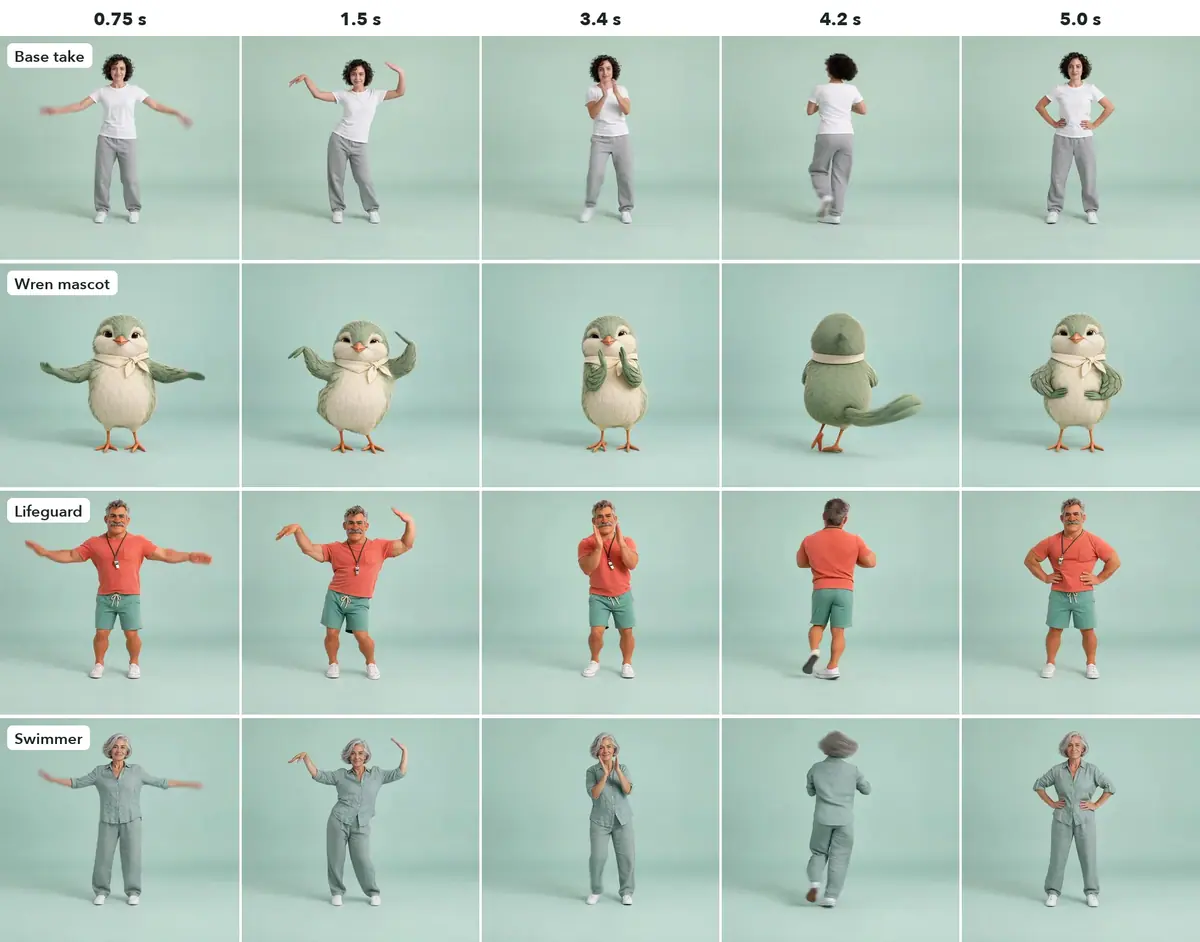
Score five key poses (Review with a score). Pick moments with a clear pose in the base take: arms out (0.75 s), arms up (1.5 s), clap (3.4 s), back to camera mid-turn (4.2 s), hands on hips (5.0 s). Export them from every take and compare.
Shellfor t in 0.75 1.5 3.4 4.2 5.0; do ffmpeg -ss $t -i take.mp4 -frames:v 1 pose-$t.png; done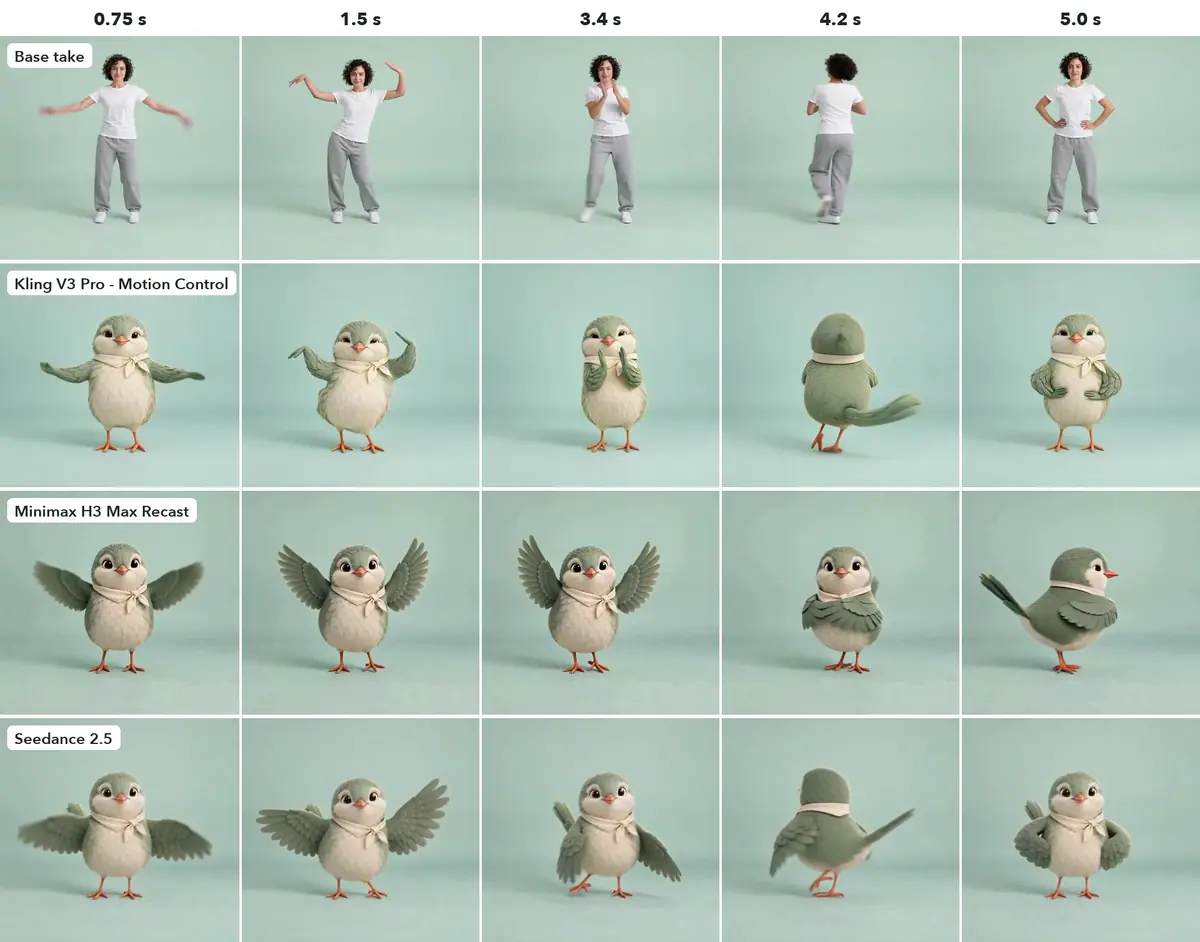
Rows: base take, Kling, Recast, Seedance. Columns: 0.75, 1.5, 3.4, 4.2, 5.0 s. -
Recast the other two with the winner, Kling V3 Pro - Motion Control. The cast still is the character image, the silent base take the motion video; character orientation from the video, original sound off. Same prompt, new character and costume sentence. 3 minutes 56 seconds and 3 minutes 28 seconds, in parallel. This model ran through the Scenario MCP; its web panel labels were not checked.
-
Repair the face that drifted (Repair at the cheapest stage). Every pose landed, but by the last second the swimmer's face had narrowed into another woman's: a photoreal face is small in a full-body frame. The stylized lifeguard held. Make a close-up from the cast still (33 seconds) and pass it to Kling as an element.
PromptHead-and-shoulders close-up portrait of the same woman as in image 1: the same invented woman in her seventies with chin-length wavy silver hair, the same face, the same small pearl earrings if any, the same sage-green linen shirt collar. She faces the camera with the same friendly closed-mouth smile, in the same soft even studio light against the same plain mint-green background. Keep her face exactly the same as in image 1. No text, no logos.The element takes the close-up as its frontal image and the full-body still as its reference image. Add one sentence to the prompt: "Her face is the face of @Element1 in every frame: the same woman in her seventies with wavy silver hair." The re-run took 3 minutes 26 seconds, at the same price. The face held to the last frame.
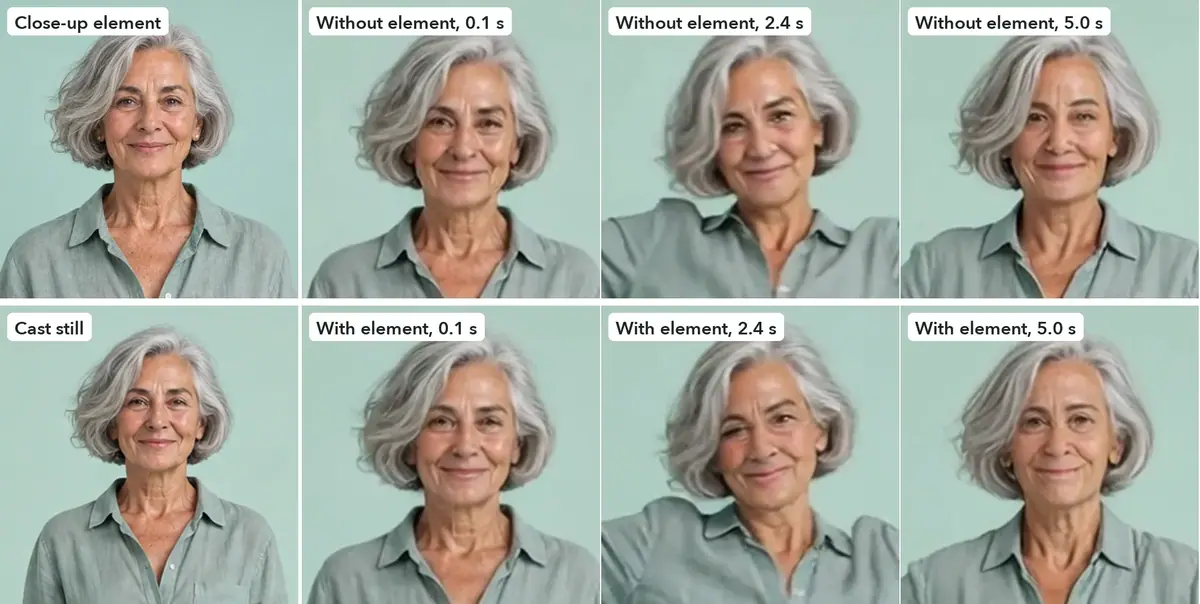
Left: the close-up and the cast still. Top: first run, the face narrows by 5.0 s. Bottom: with the element, the same woman to the end. -
Conform and pair (Conform clips before the edit). Kling returns 1920x1088 at 30 fps; the base take is 1344x768 at 24 fps, both 5.17 seconds. Match the base take, then stack:
Shellffmpeg -i recast.mp4 -vf "scale=1344:768:force_original_aspect_ratio=increase,crop=1344:768,fps=24" -frames:v 124 -an recast-1344.mp4 ffmpeg -i base-1344.mp4 -i recast-1344.mp4 -filter_complex hstack -an side-by-side.mp4Seedance returned 121 frames at 480p; pad its last frame (
tpad=stop_mode=clone:stop=3) so every take has 124.
With the Scenario MCP: model_run on model_kling-v3-pro-motion-control with image (cast still), video (silent base take), characterOrientation: "video", keepOriginalSound: false.
For the face, add elements: [{frontalImage: closeUp, referenceImages: [castStill]}] and name @Element1 in the prompt. Each run cost what its dry_run: true quote said, with or without the element.
Check the result
at each key moment the character holds the base take's pose; the feet stay on the same spot; the whole body stays in frame; the camera does not move; costume and face hold to the last frame.
a pose arrives late or early; the camera reframes; a limb leaves the frame; the face or costume changes mid-clip; a second character appears.
| Shoot-out on the mascot | Kling V3 Pro - Motion Control | Minimax H3 Max Recast, 768P | Seedance 2.5, 480p |
|---|---|---|---|
| Key poses on time | 5 of 5 | 2 of 5, late from 3 s | 4 of 5, no clap |
| Framing | locked, full body | locked, full body | locked, full body, mascot drawn larger |
| Mascot design | held | held | held |
| Motion rhythm (correlation with the base) | 0.85 | 0.24 | 0.82 |
| Wait | 4 min 23 s | 1 min 23 s | 5 min 55 s |
The rhythm row follows the tempo and gives Seedance almost the same score as Kling, though it misses the clap; the key poses decided.
| Final recasts | Wren mascot | Lifeguard | Swimmer |
|---|---|---|---|
| Key poses on time | 5 of 5 | 5 of 5 | 5 of 5 |
| Design and face to the last frame | held | held | held with the face element |
| Camera lock (background change, max) | 0.47% | 0.56% | 0.53% |
Camera lock compares the left and right 12% of each frame with frame 0; the base take itself scored 0.41%.
Watch the video: https://ufgc0c9mhl4ueq76.public.blob.vercel-storage.com/academy/c2c4474a57e01db530166e257baac81d99f161caf06d30d055cdc9177876de64.mp4
1Key poses at 0.75, 1.5, 3.4, 4.2 and 5.0 seconds: the base take on top, then three takes of the wren mascot. Which take passes the brief?
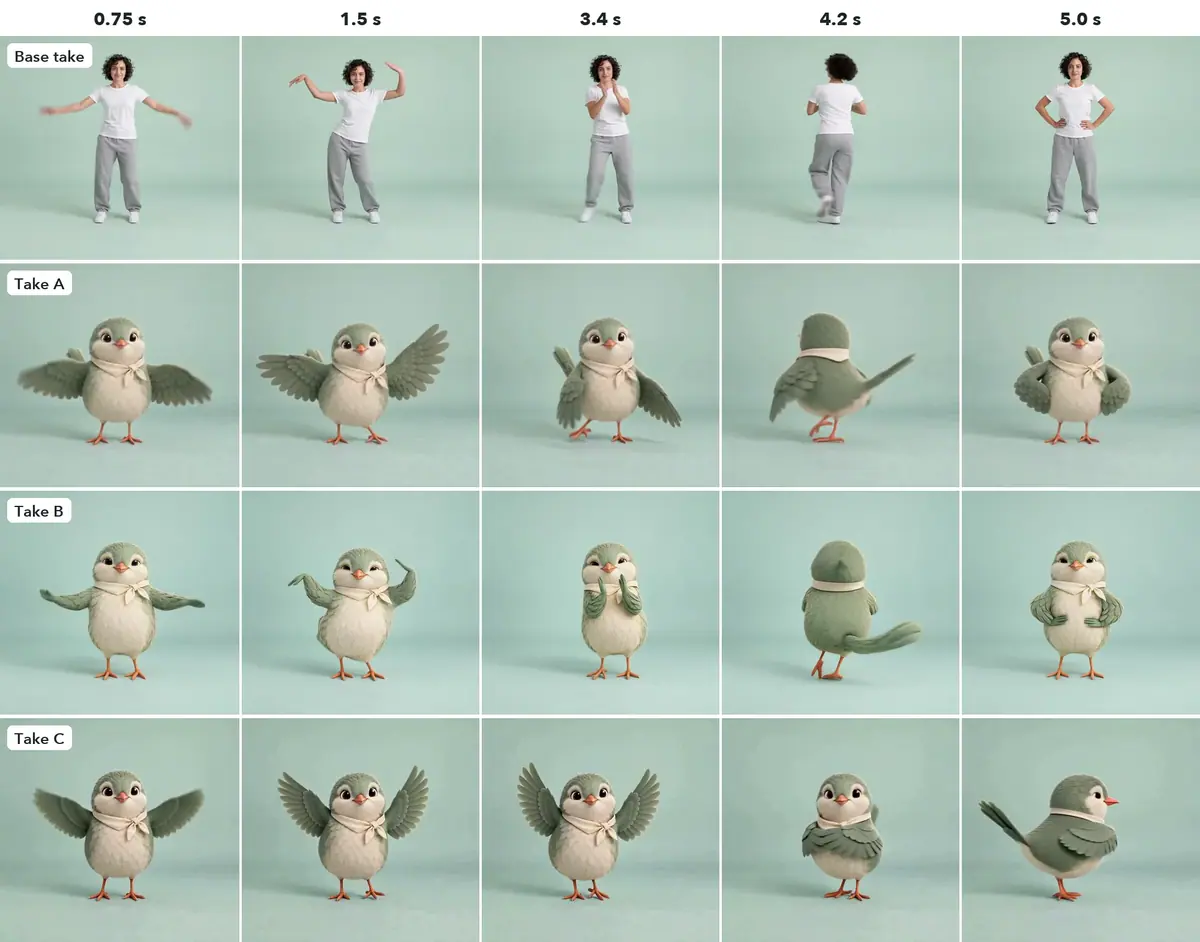
Answer: B. Every key pose has to land at the same time as in the base take. Take A spreads its wings where the dancer claps; Take C still has its wings up at the clap and faces front at the turn.
2In the swimmer recast, every pose lands on time, but by the last second her face belongs to another woman. What do you do?
Answer: B. Design and face must hold to the last frame. A close-up element named in the prompt kept the same woman to the end.
Make it repeatable
- Keep the base take as the master. A new character is one cast still and one transfer away.
- Template the cast still (Batch from a template): fixed pattern, one character slot.
- Build it as a workflow (Package it as a workflow or skill). In the Node Editor: a Video node for the base take, a Text node with the character sentences, Split Text, a Loop (its Input List port), an Image Generator on GPT Image 2.5 Sunburst with the performer still, a Video Generator on Kling V3 Pro - Motion Control, and an Approval after the first character.
- Store the five key moments with the base take, so every review checks the same frames.
- Plan the element for photoreal faces. In this run and the previous test, the photoreal character was the one whose face drifted; the stylized ones held.
- Iterate on the cheaper tier. Kling V3 Std - Motion Control quoted about three quarters of the Pro price for this clip; run finals on Pro.
Runs and time
| Step | Runs | Kept | Wait |
|---|---|---|---|
| Performer still, two takes | 1 | 1 | 32 s |
| Base take, 5 s, 768P | 1 | 1 | 3 min 12 s |
| Cast stills | 3 | 3 | about 33 s, in parallel |
| Shoot-out on the mascot | 3 | 1 (Kling) | 1 min 23 s to 5 min 55 s, in parallel |
| Lifeguard and swimmer recasts | 2 | 1 (swimmer rejected) | 3 min 56 s, in parallel |
| Face close-up | 1 | 1 | 33 s |
| Swimmer with the face element | 1 | 1 | 3 min 26 s |
| Conform, checks, pairs (local) | 0 | n/a | seconds |
About 18 minutes of waiting. The video runs are almost all of the cost; more than half went to the two shoot-out losers and the rejected swimmer take.
The price shows on the Generate button before you run; with the Scenario MCP, ask for a dry-run quote.
Variations
- Brand: the mascot in a seasonal costume, from the same base take.
- Games: an emote set for non-player characters: one performer take per emote, any number of characters.
- Learning: a presenter's gesture take reused by a course mascot.
- Sound: keep the original sound with Kling's sound option, or add music after the conform.
- Same performer, new look: restyle the clip instead of recasting it. See Restyle footage, keep the motion.
- Your own take: a phone video of you acting it out is a valid driving video. See Direct the camera and motion.
If it breaks
- Poses arrive late. Use a motion-control model and keep the clip short.
- The camera reframes. Reference-video models may build a new shot: use a motion-transfer model and write "static locked-off camera".
- Hands leave the frame. Keep the hands no higher than the head in the base take, and leave room around the performer.
- A face drifts. Add a face close-up as an element, with the full-body still as its reference image, and name it in the prompt.
- An element run fails at once. In the v6 test, an element with a frontal image alone failed; adding the full-body still as a reference image fixed it.
- Proportions break. Pilot the most different character first, and place its still on the performer's spot.